
Tom Hiddleston Has Range. So Does His Workout.
The Tom Hiddleston workout described in his September 2026 Men's Health interview combines running, strength, sprint work and mobility, with preparation shaped by the role. For Tenzing, that means training for the demands of playing mountaineer Edmund Hillary, not simply adding camera-friendly bulk. The useful idea is variety with a purpose. Borrow the balance, not an actor's workload, and keep any inspired-by plan separate from what he actually reports doing.

.jpg)
Some workout stories arrive wearing a lab coat they ordered with express shipping. An actor looks good, a photograph circulates, and suddenly the internet has his exact Tuesday leg session. How convenient. His trainer must be thrilled to discover the spreadsheet.
Here, there is an actual interview to work from. There is also a useful question underneath the celebrity packaging: what would you train if the goal were to do more things well, rather than win the locker-room lighting lottery?
For the wider TSS collection, start with our celebrity workout routines hub. This installment keeps the reporting and the adaptation in separate rooms. They may mingle later, but they are not sharing an identity.
What does the Tom Hiddleston workout actually include?
In Christopher Riley's Men's Health interview, Hiddleston describes preparation involving longer runs, sprint shuttles, leg strength, upper-body work, pull-ups, core and mobility. Trainer Simon Waterson is part of that story. The article also describes an accumulating five-exercise format interspersed with cardio.
That is a set of reported training components, not a complete public training diary. It does not give us permission to invent a weekly split, attach precise lifting loads or announce that he eats a particular breakfast before every session.
The editorial appeal is the range. You can appreciate an impressive pair of shoulders and still ask whether the program has room for anything beyond maintaining them. Both thoughts are allowed. We are a sophisticated publication, occasionally.
If you already lift, the question is whether your week has a deliberate place for aerobic work. If you mostly run, ask where strength fits. The CDC's adult activity guidance recommends both: at least 150 minutes of moderate activity, or 75 minutes vigorous, plus muscle strengthening on at least two days each week. That is public-health guidance, not Hiddleston's personal prescription.

What is the physique goal for Tenzing?
Hiddleston tells Men's Health that preparing to play Hillary called for aerobic fitness and the qualities of a lean, long-limbed climber. The target belongs to the character and the work, rather than a generic instruction to become bigger.
A numerical transformation would make a tidy headline. It would also require verified starting and finishing measurements, which this reporting does not provide. We are leaving out the imaginary body-fat percentage. It has had quite enough exposure elsewhere.
Think of physique here as context, not a shopping specification for your own body. A photograph can illustrate the person being discussed; it cannot reveal his program, recovery, health or the precise contribution of any one exercise. Editorial photos in this article are identified by their actual event, not presented as training evidence.
You can admire the result without making another person's proportions your performance review. A more useful question for your next session is what you want to improve: a movement, a skill, your consistency or the place exercise occupies in your week.
Should you copy the hardest session in an interview?
No workout earns extra relevance merely because its nickname sounds like an incident report. Before copying any celebrity session, ask what it was for, who it was built for and how it fits with the rest of your week. If those answers are missing, you have an entertaining description, not a personalized plan.
Choose your own starting point. The CDC explicitly notes that some activity is better than none and that activity can be broken into smaller chunks. You do not have to audition for a film to justify a walk, and you do not have to turn every run into an ordeal to make it count.
For a different celebrity-training story, read our Brandon Sklenar profile or Pierson Fode feature. Treat each as its own reported context rather than combining the most dramatic parts into a Frankenstein program. The monster has enough problems without your hamstrings.


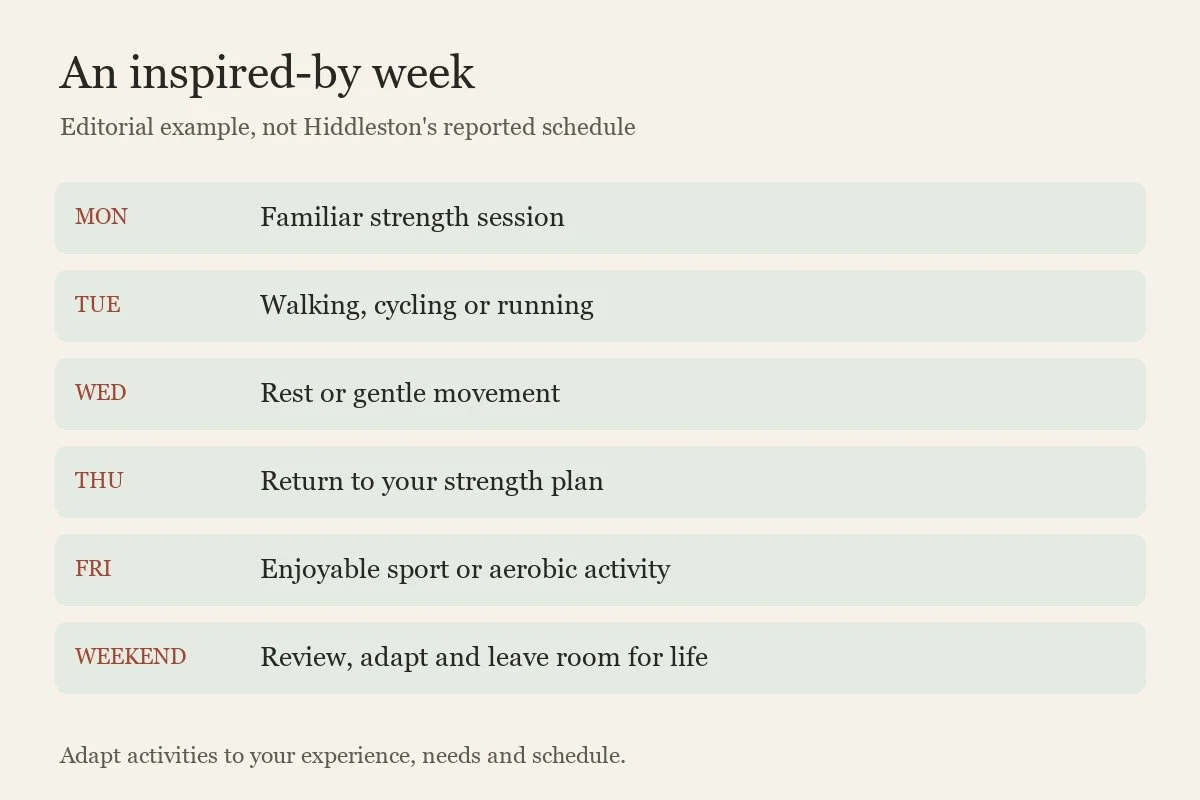
What could an inspired-by sample week look like?
This is an editorial planning example inspired by the mix of activities, not Hiddleston's routine or a plan supplied by his trainer. It is a way to organize familiar activities around your own experience and schedule. Choose suitable exercises and workloads with a qualified professional if you need help adapting them.
How could you arrange the weekdays?
Monday: make room for strength. Use a familiar full-body session appropriate to your experience. Decide what you will do before arriving, rather than collecting exercises because the equipment happens to be free. Keep a note of what you completed so the next session starts with information instead of theatre.
Tuesday: choose an aerobic activity you will actually repeat. That might be brisk walking, cycling or running, depending on your starting point. Choose the route and available time in advance. A manageable appointment in your calendar is more useful than an ambitious plan that requires your entire life to develop supporting-character energy.
Wednesday: leave some breathing room. Use the day to review how the week fits together. If you enjoy gentle movement, make space for it; if your schedule needs a rest day, put it here. Rest does not need a dramatic caption or a collection of recovery gadgets to be a legitimate calendar entry.
Thursday: return to strength. Keep the session connected to Monday's plan rather than searching for novelty at every station. If a trainer has given you a program, follow that structure. This example is not an invitation to replace it with something assembled from a celebrity interview and optimism.
Friday: choose an enjoyable skill or activity. A sport, a walk with a friend or another suitable aerobic session can occupy this space. Pick something you want to show up for. The point is to give your week a reason to continue after the initial enthusiasm has stopped answering messages.
What belongs on the weekend?
Use the weekend to make the schedule realistic, not to punish yourself for missed appointments. Review the week's activity, decide where another suitable session fits and leave room for the rest of your life. This outline intentionally does not assign lifting loads or sprint targets; those choices need more information than your admiration for an actor.
Try writing the next week's appointments before buying anything. If there is no practical time or place for a proposed session, solve that problem first. The calendar is less glamorous than a new training shoe, but considerably harder to blame.
What should happen to your skin after training?
The post-workout routine does not need the production budget of the workout story. The American Academy of Dermatology recommends gentle face washing after heavy sweating, using lukewarm water and fingertips rather than scrubbing. Your towel is not an exfoliation device with a gym membership.
For outdoor sessions, AAD workout guidance recommends broad-spectrum, water-resistant SPF 30 or higher. Follow the product's directions rather than treating its sports branding as a contractual promise to last all day.
Our skincare guide for men who work out covers the rest: washing, shaving, clean kit and researched basics. These are general skincare recommendations, not claims about products Hiddleston uses. This profile has no celebrity-endorsed shopping basket hiding beneath the reporting.
FAQ: What else should you know?
Is this his exact weekly training schedule?
No: the interview describes training components and role preparation, not the sample calendar above. The calendar is an explicitly labeled editorial adaptation.
Does every session need to be intense?
The CDC includes moderate activity in its adult recommendations. Choose an appropriate starting point rather than using a celebrity story as an intensity requirement.
Can you build the week around walking instead of running?
Brisk walking counts as moderate aerobic activity in CDC guidance. Your plan does not lose its dignity because it has a sensible entry point.
Are the skincare products in the linked guide his favorites?
No celebrity product use is being claimed here. The linked guide contains researched editorial picks, clearly separated from this interview-based profile.
Sources
- Men's Health: How Tom Hiddleston, 45, Builds Total Fitness: Hollywood Workouts, Death Runs and Real-World Strength, September 2026.
- CDC: Adult Activity: An Overview, December 2023.
- American Academy of Dermatology: Face washing 101, accessed October 2026.
- American Academy of Dermatology: Is your workout causing your acne?, accessed October 2026.