
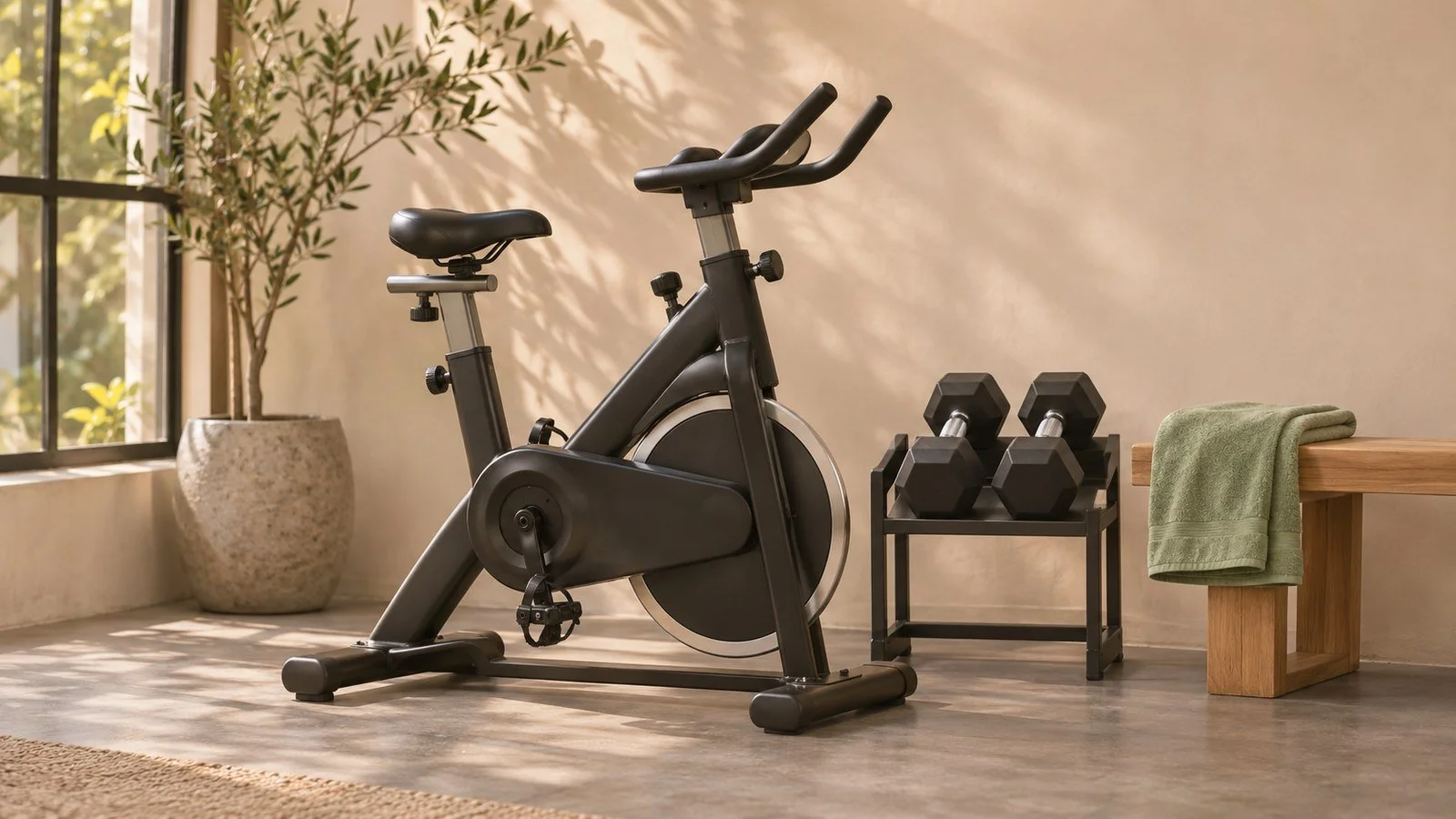
Cardio and muscle growth can coexist. A 2026 review of meta-analyses found broadly comparable strength and muscle-size outcomes when combined training was compared with lifting alone, alongside better aerobic fitness. That does not make every combination equally suitable: your main goal, the outcome being measured and the way sessions fit together still matter. Keep the cardiovascular work; give it a sensible place in the calendar instead of treating the exercise bike as a burglar.
You finish lifting, glance at the treadmill and briefly behave as though it has been caught selling your shoulders on the secondary market. An impressive amount of suspicion for a machine that mostly holds someone's sweatshirt.
The useful question is more specific than whether cardio is good or bad. Are you trying to build muscle, improve your squat, prepare for a race or get better at producing force quickly? You can want several things. You should still know which one gets priority when the calendar becomes ridiculous.
This is a guide to that decision, not a promise that every training plan delivers identical results. The goal is a week you can explain without invoking sabotage.
What does the research say about cardio and muscle growth?
The Schumann systematic review compared combined aerobic and resistance training with the same resistance-training prescription performed alone. Across 43 studies, it found no clear overall disadvantage for whole-muscle growth or maximal strength, but smaller improvements in explosive strength with combined training.
Those are separate outcomes. Muscle size concerns growth; maximal strength concerns force; explosive strength concerns producing force rapidly. The review treats them separately for a reason. Turning every result into the single word gains makes for an excellent argument and a poor training decision. Source: study outcomes and conclusions.
The newer Held umbrella review, published online in February 2026, also supports combined training for broad fitness in recreationally trained people. It cautions that evidence in highly trained and elite athletes remains scarce. An umbrella review summarizes existing reviews; it is not a fresh experiment conducted on everyone who owns a lifting belt.
Our reading: the blanket warning that cardio inevitably ruins muscle growth is too crude. Equally, a reassuring average is not permission to stop thinking about what you are actually asking your week to accomplish.
Does that mean the interference effect is imaginary?
No. It means the answer changes with the question. A review examining individual muscle fibers found a possible small disadvantage for fiber growth with combined training, unlike the broader whole-muscle findings. Its preliminary running-versus-cycling result was most apparent for type I fibers, not a universal declaration that running destroys muscle.
Another meta-analysis focused on sex and training status found reduced lower-body strength gains in men, but not women, with combined training. It did not have enough muscle-growth data to settle that separate question, and called for more research in women and highly trained athletes.
That is a more useful picture than either internet extreme. There can be tradeoffs, and the evidence does not give every person, outcome and program the same answer. Neither your running shoes nor your barbell needs a defense attorney.
Before applying a dramatic claim, ask what the researchers measured. Smaller improvement in a particular test is not interchangeable with losing existing muscle. Read the comparison, the participants and the outcome before promoting a headline into a rule for your own training.
Should you lift before or after cardio?
When both happen in one session and lower-body strength is your main goal, lifting first is a reasonable option to discuss with your coach. A 2018 sequence meta-analysis favored strength-before-endurance for lower-body strength development, while improvements in aerobic capacity were not clearly affected by order.
Keep that recommendation proportionate. The 2026 umbrella review did not establish a significant overall sequence effect. The evidence offers a planning consideration, not an international ban on touching a bike before a dumbbell.
An illustrative scheduling conversation might sound like this: if your next training block is primarily about lifting, ask whether the demanding lifting work should have first claim on the session. If the priority is an event, take the event plan to a qualified coach rather than inserting an unrelated bodybuilding schedule on top.
Write the priority down before negotiating the order. Otherwise, everything becomes essential and your lunch break becomes an endurance sport of its own. A plan should have an answer to the question, what are we trying to improve here?
Do cardio and lifting need separate days?
Not as a universal rule. In the Schumann review, the explosive-strength disadvantage was more apparent when both modes occurred in the same session; the subgroup with sessions separated by at least three hours did not show that clear effect. That does not establish a precise waiting period that guarantees results for everyone.
If rapid force production matters to your sport, separation deserves more attention than it does in a vague plan to be generally fitter. Ask a coach to help resolve competing priorities rather than taking a single subgroup result and building your entire personality around a stopwatch.
For ordinary scheduling, start with the time you really have. Our editorial suggestion is to put fixed commitments on the calendar first, then choose a repeatable arrangement. A theoretical seven-day masterpiece that you abandon on Tuesday is an ambitious piece of fiction.
You are allowed to choose practicality. You are also allowed to change the arrangement if the important work repeatedly gets squeezed out. Neither decision requires declaring an entire category of exercise your enemy.
How much cardio belongs in a general fitness plan?
For adults, the CDC recommends at least 150 minutes of moderate aerobic activity weekly, or 75 minutes of vigorous activity, or an equivalent combination, plus muscle-strengthening activity on at least two days. These are public-health guidelines, not a bespoke hypertrophy program or a race plan.
You do not have to complete the aerobic activity in one heroic appointment. The same guidance allows it to be spread through the week in smaller chunks. Brisk walking is one example of moderate activity. The gym does not have exclusive distribution rights to movement. Source: CDC adult activity guidance.
To understand effort, the CDC's talk test is useful: at moderate intensity you can generally talk but not sing; vigorous activity makes more than a few words difficult without pausing for breath. It is a rule of thumb, not a laboratory measurement.
The important editorial distinction is between a health baseline and an optimization claim. A weekly guideline does not tell you the perfect arrangement for your particular squat target, nor does a performance debate erase the broader reason to include aerobic activity.
What should you track instead of blaming the treadmill?
Keep a plain record of the sessions you planned, the ones you completed and the outcome you care about. Note when the schedule changes. This is an organizational suggestion, not a diagnostic test or a replacement for coaching.
Be specific in the review. Did the lifting session disappear because a run overran? Are you adding work without deciding what makes room for it? Are you comparing a carefully followed month with a week spent traveling? Useful questions are less glamorous than a villain, but considerably easier to act on.
Keep the rest of the gym routine similarly practical. Our skincare guide for men who work out covers the bathroom side of training, while the lifting hand-care guide addresses palms and calluses. For outdoor sessions, see our chapped-lips guide.
No product purchase is required by this article. First decide what you want from your training. Then give both forms of exercise a job. The cardio equipment can remain in the building without being added to a police report.
FAQ: What else should lifters know about cardio?
Can you build muscle while doing cardio?
Yes: the 2026 umbrella review supports combined training for recreational fitness, with broadly comparable muscle-size outcomes to resistance training alone. That is not a guarantee for every program or athlete.
Is running worse than cycling for muscle growth?
The muscle-fiber review found preliminary evidence of greater interference with running for type I fibers. That finding does not establish that all runners lose muscle or that cycling is universally optimal.
Must strength training always come first?
The 2018 sequence review supports lifting first when lower-body strength is the priority. Treat it as one planning consideration rather than a rule that fits every goal.
Does brisk walking count as cardio?
The CDC includes brisk walking as moderate aerobic activity. It does not have to look dramatic to belong in a general activity plan.
Sources
- Sports Medicine: Compatibility of Concurrent Aerobic and Strength Training for Skeletal Muscle Size and Function, online November 2021, issue March 2022.
- Sports Medicine via German Sport University Cologne: Maximizing Adaptations in Concurrent Training, February 2026.
- Sports Medicine: The Effects of Concurrent Aerobic and Strength Training on Muscle Fiber Hypertrophy, April 2022.
- Sports Medicine: Concurrent Strength and Endurance Training, Impact of Sex and Training Status, October 2023.
- Journal of Sports Sciences: The Physiological Effects of Concurrent Strength and Endurance Training Sequence, June 2018.
- CDC: Adult Activity, An Overview, December 2023.
- CDC: How to Measure Physical Activity Intensity, December 2025.